

Curved Menu Systems
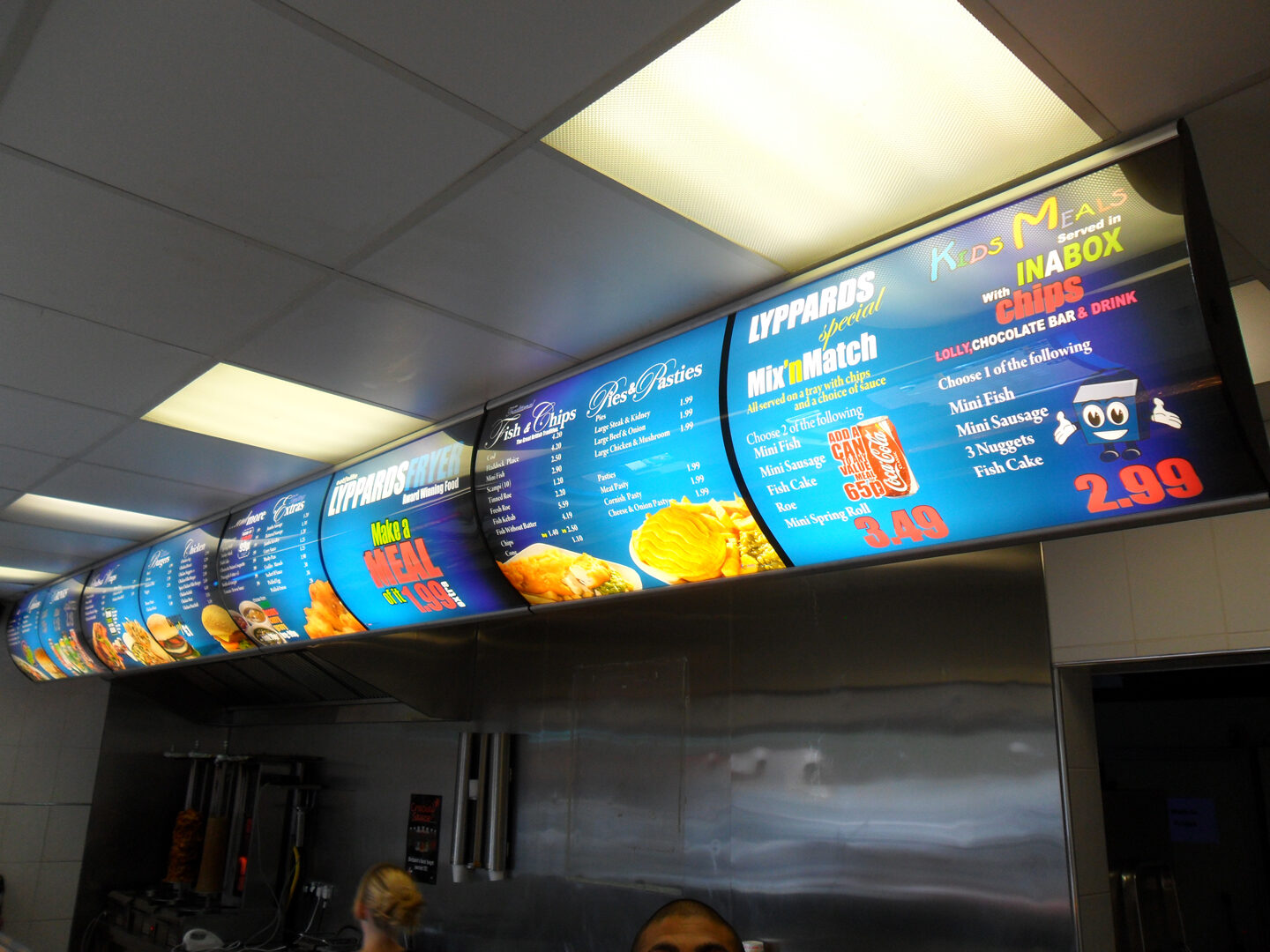
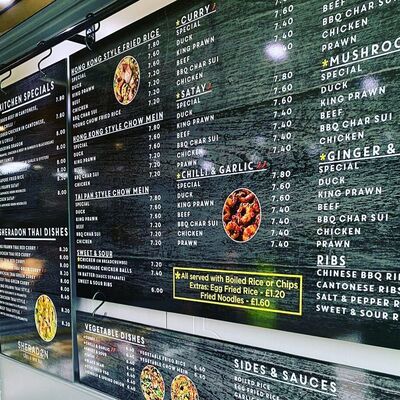
Curved menu systems bow gently out from the wall or drop from the ceiling, so the face is angled towards the room rather than flat against it. The practical effect is that the board is readable from the queue, from the seating and from the door — and the curve catches the light in a way a flat panel never does.
Last updated
Curved Menu Systems, made properly
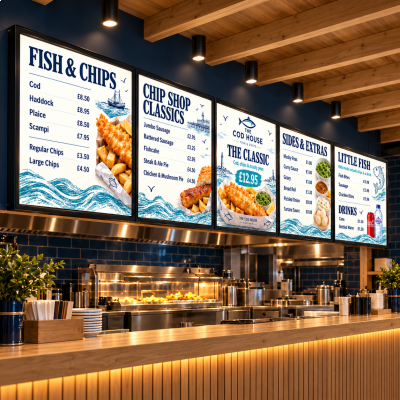
The panel is printed on a flexible substrate and tensioned into a curved aluminium frame, lit from behind with LED. Runs can be built as one long sweep above the counter or as separate vertical panels down a wall, which is a good way to give each part of the menu its own space. Panels come out and go back in without dismantling the frame, so updating one section is straightforward.
- Convex face stays readable across the room
- LED lit for a clean, even glow
- Horizontal runs or individual vertical panels
- Panels change without dismantling the frame
What should you know before ordering curved menu systems?
Should a curved menu go on the wall or hang from the ceiling?
Wall-mounted works over a counter with a clear wall behind it. Ceiling-hung works for an open counter, a food court unit, or a back wall already taken by equipment and extraction. BD Signs looks at where people stand to order and where they sit, then sets the height and position so the curved face is angled at them. Mounted either way, the bow is what keeps the board readable across the room.
Is one long curve or separate vertical panels better?
A single sweep above the counter reads as one menu and suits a focused offer. Separate vertical panels down a wall give each part of the menu its own space, with kebabs on one, pizzas on the next and burgers on a third, which helps when the range is wide. BD Signs plans the split alongside the menu design, so every panel holds a complete section and the eye moves through them in order.
Why choose a curved menu over a flat one?
Because customers rarely stand square to the board. A flat face reads best from straight in front; a convex one turns towards the queue, the seating and the door at once, and catches the light along its curve. BD Signs suggests curved where the room is wide or people order from a queue, and a flat menu box where everyone faces the board at the counter. You can compare both, lit, at our Nottingham showroom.
How does BD Signs make curved menu systems?
Designed in-house, manufactured in our own factory, fitted by our own teams. 30 years in the industry.
- Step 1
Survey the room
BD Signs measures the wall or ceiling and watches where customers queue, sit and come in, so the curve faces the people who need to read it. We check the fixing points and where power for the LEDs can reach.
- Step 2
Laying out the menu
Our designers split the menu across the sweep or the vertical panels, allowing for the curve so type and prices sit where they read cleanly. You approve a visual of the full system before printing starts.
- Step 3
Printing and framing
Each face is printed on a flexible substrate and tensioned into a curved aluminium frame in our own factory, with LED lighting behind it for a clean, even glow across the panel.
- Step 4
Fitting and handover
Our own teams fix the frames to the wall or drop them from the ceiling, connect the LEDs and line the run up level. You are shown how a panel comes out, so updating one section never means taking the frame apart.
Curved menu or flat menu box: which reads better in your shop?
Both are LED lit and both take printed panels that can be changed. The difference is the angle of the face and the space around your counter.
| Compare | Curved menu system | Flat menu box |
|---|---|---|
| Viewing angle | Convex face turns towards the room and reads from the side | Reads best from straight in front |
| Mounting | On the wall or dropped from the ceiling | Fixed flat to the wall above the counter |
| Layout | One long sweep, or separate vertical panels | A run of boxes that can turn corners and step around ductwork |
| Changing the menu | Panels come out without dismantling the frame | Panels drop in from the front of each box |
| Suits | Wide rooms, food courts and queues that form at an angle | Counters where customers face the board head-on |
Curved Menu Systems we've installed
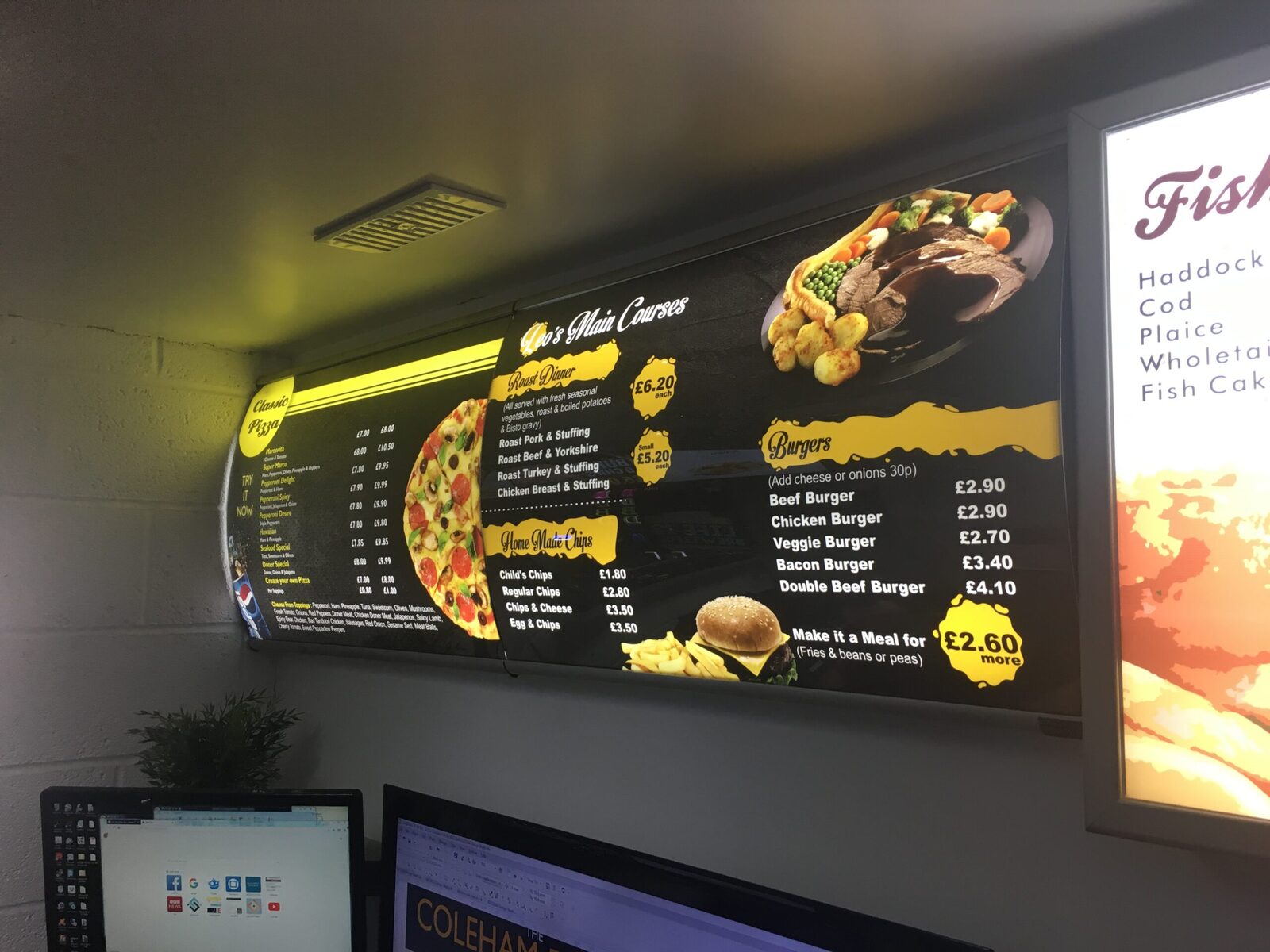
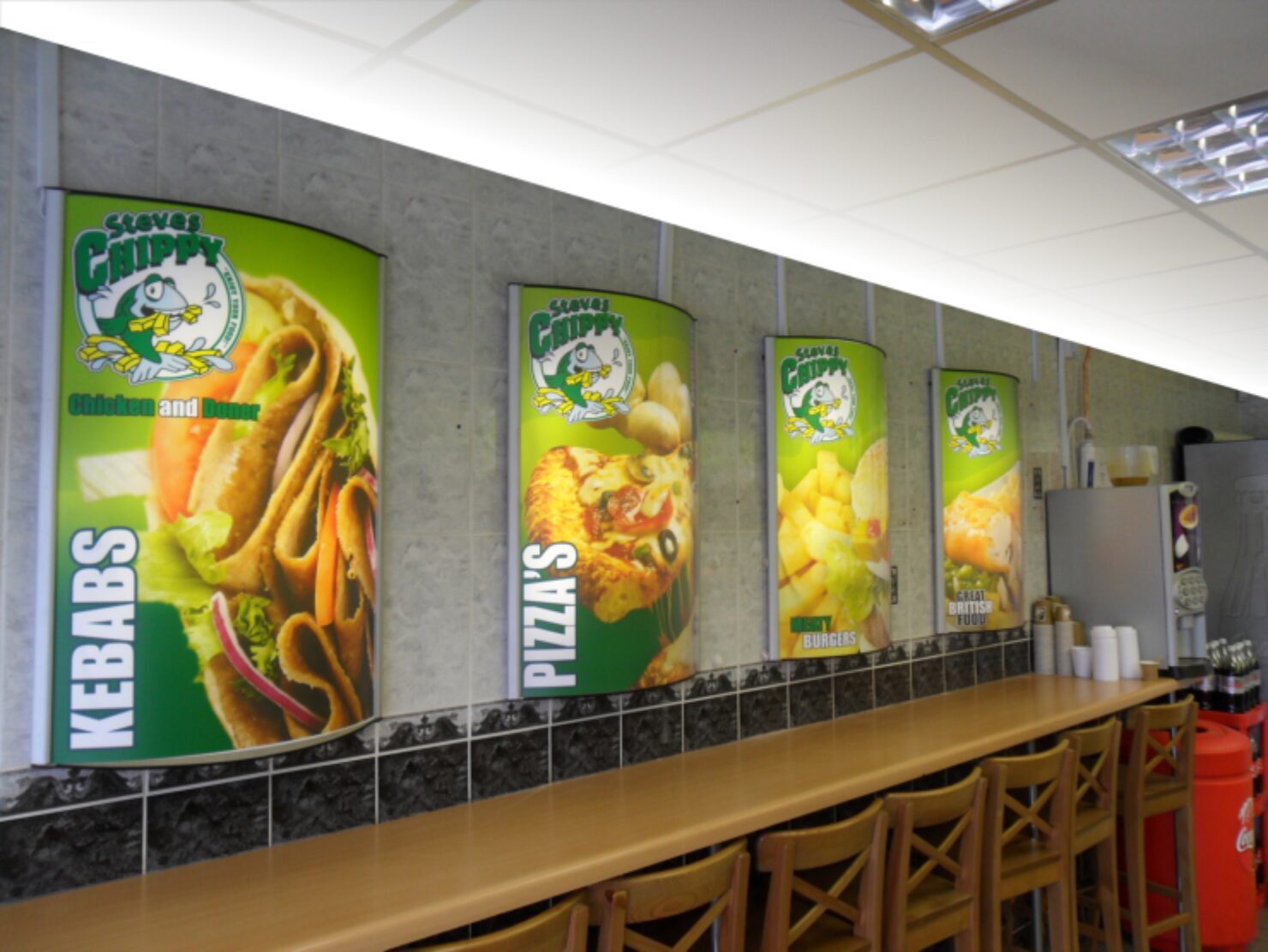
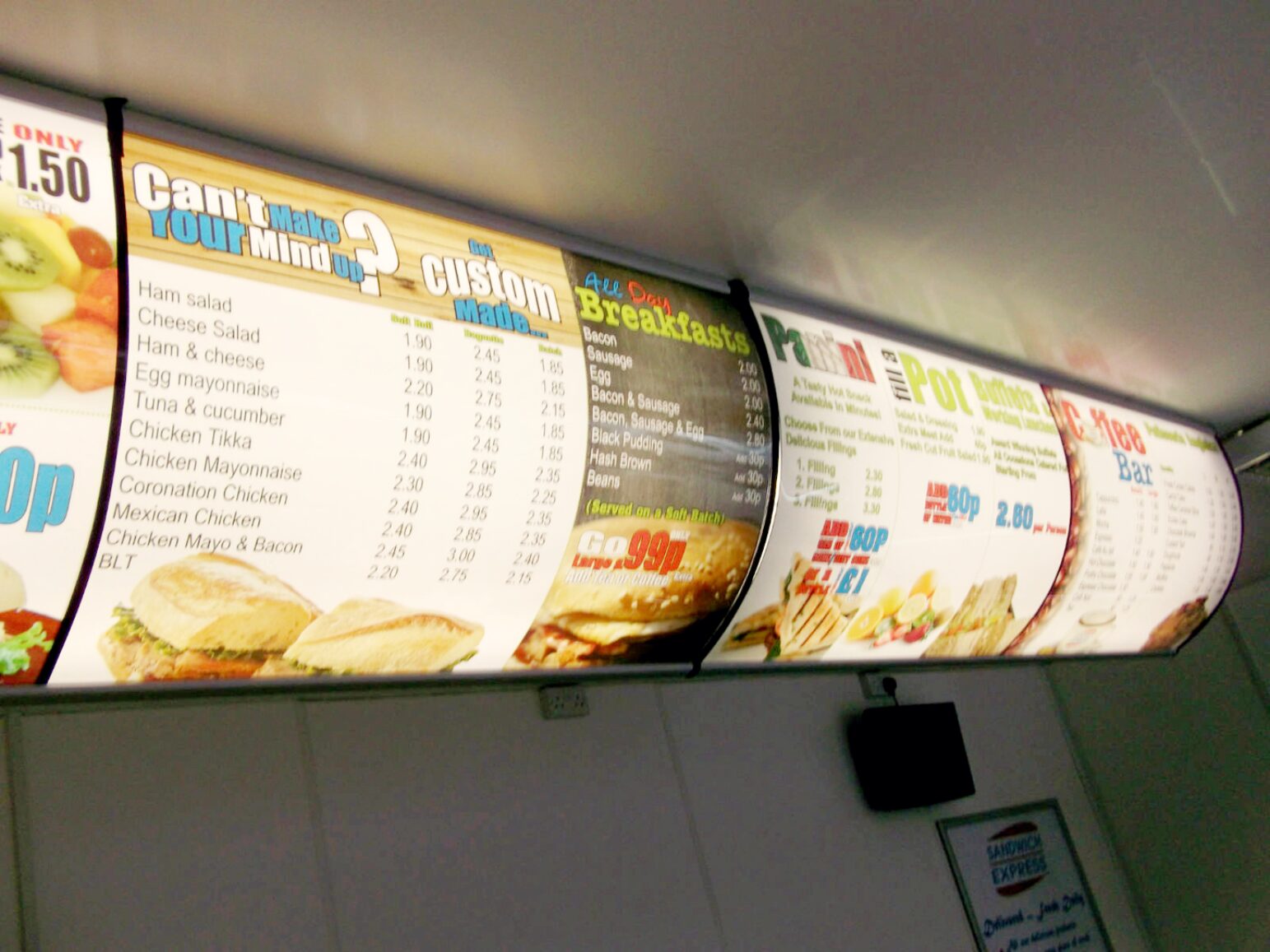
The part of the menu that keeps changing.
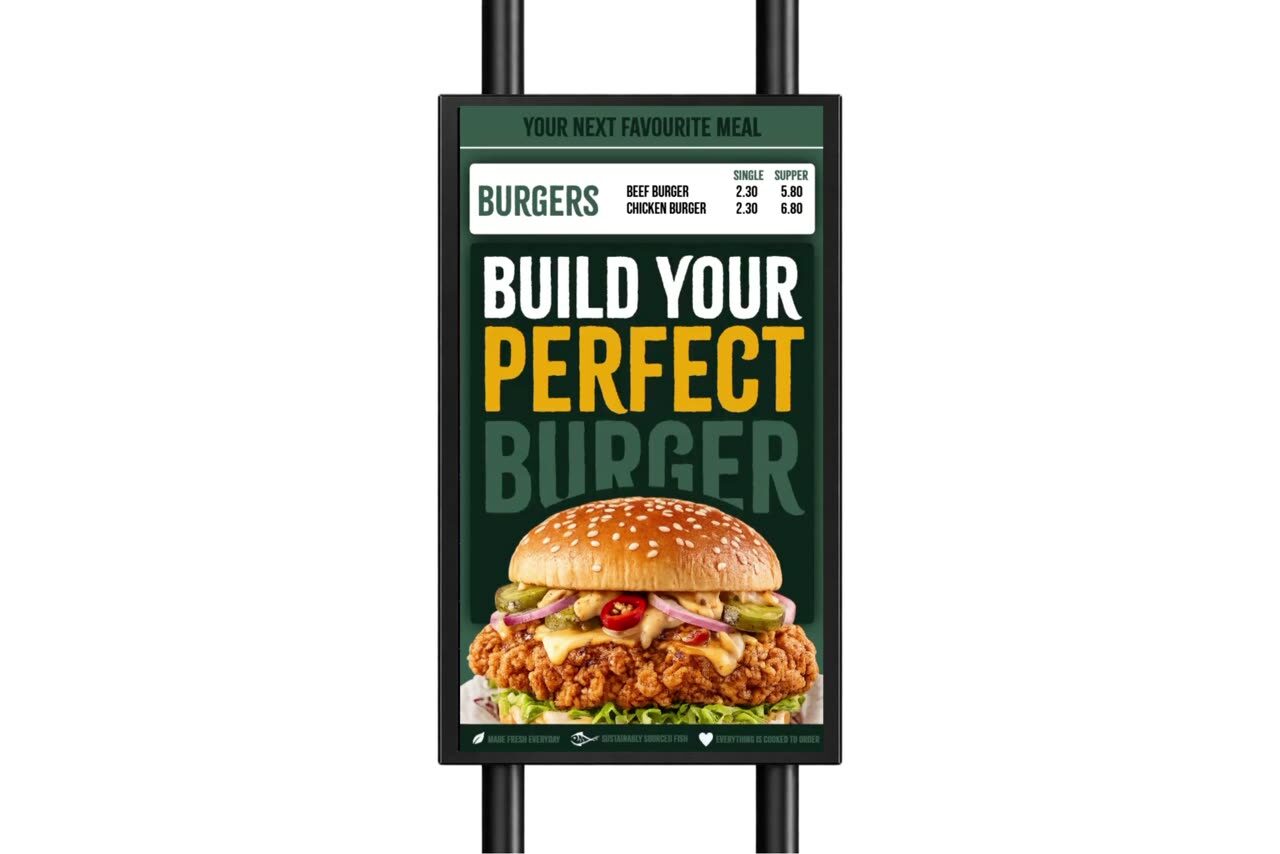
A lit panel is the right answer for a menu that stays put. It is bright, it costs almost nothing to run and it never crashes. But every menu has a part that moves — the special, the price that went up, the thing that sold out at two o'clock — and reprinting a panel for that costs you every single time.
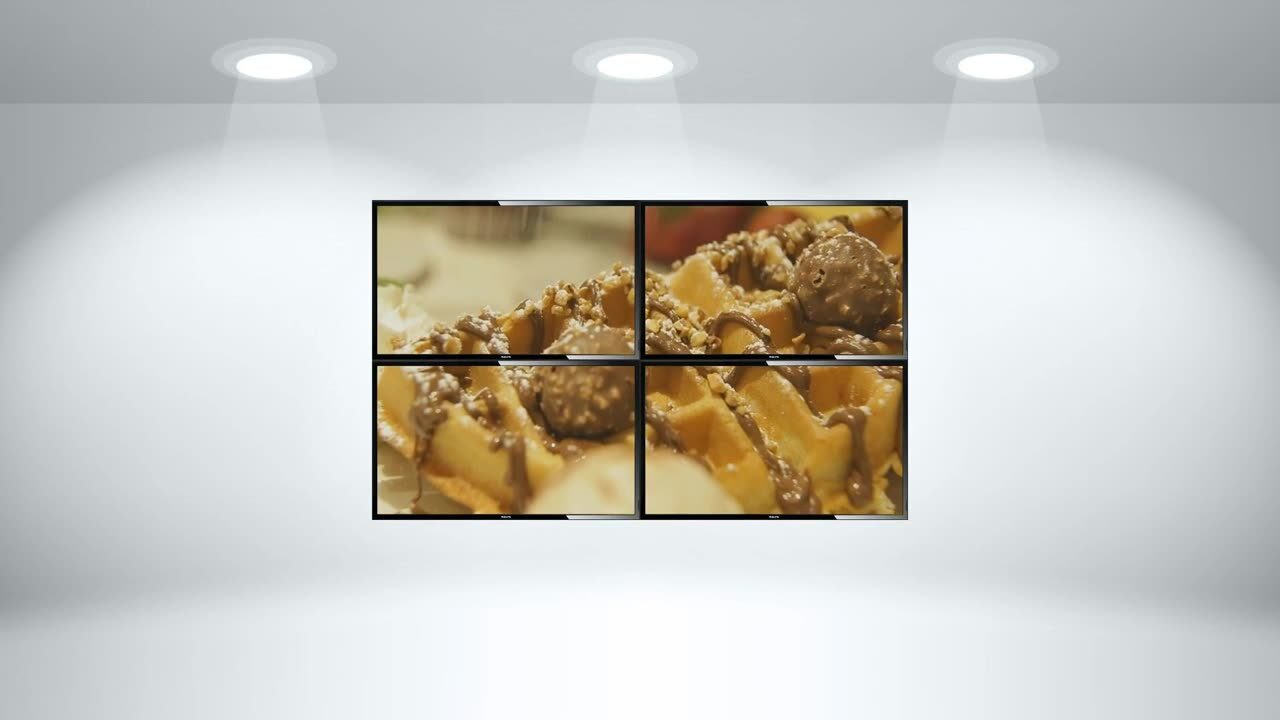
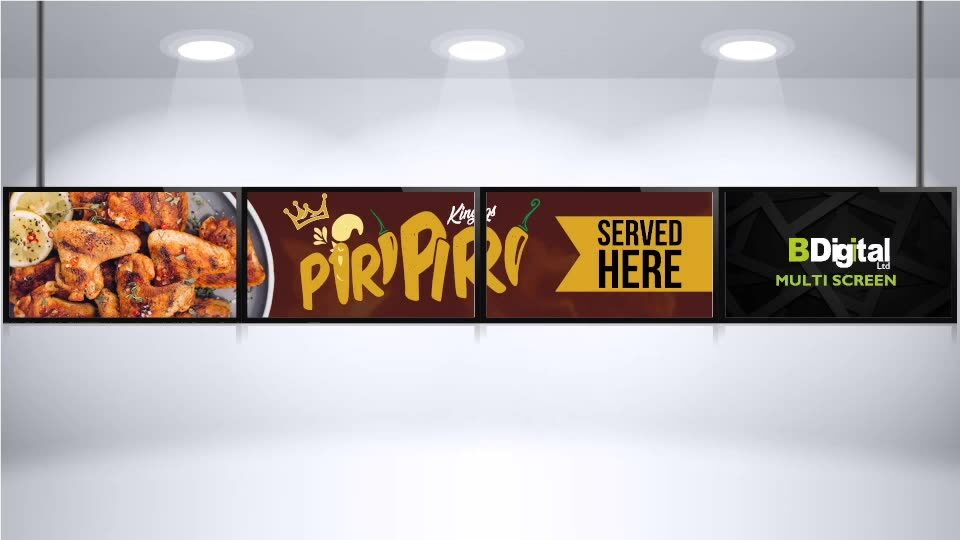
So most counters end up running both. Screens, video walls and window displays you can change from your phone. We build the first set of content ourselves, so it goes live looking like your brand rather than like a spreadsheet.
Our own digital menu platform, written in-house and developed over 15 years.
Both on the same wall
Lit panels for the menu that stays put, a screen for the part that moves. Specified as one scheme so the finishes match rather than nearly match.
Change a price from your phone
A printed panel costs you money every time it changes. A screen costs you a couple of minutes, from the back office or a beach.
Breakfast to lunch on a timer
The board changes itself at eleven. You stop paying for a menu that is wrong for half the day, and you stop relying on somebody remembering.
No design fee to put up an offer
Thousands of templates and food images come with the platform, and our designers keep adding to them. A new special takes minutes instead of a quote.
What do people ask about curved menu systems?
Can one panel of a curved menu be changed on its own?
Yes. Each printed face comes out of its curved frame and a new one is tensioned in, so updating the breakfast section or a row of prices leaves the rest of the menu alone. Send BD Signs the changes and we print a replacement to the same curve and size. With vertical panels it is simpler still, because each section of the menu already sits in a frame of its own.
Does a curved menu system need its own power supply?
Yes. The panels are lit from behind with LED, so the run needs a supply close by: on the wall for a wall-mounted sweep, or brought down from above for a ceiling-hung one. Your electrician or shopfitter puts the supply in. BD Signs marks where it should be at the survey, so cables stay hidden behind or above the frame with no leads trailing over the counter.
Can curved menus be used alongside digital menu boards?
Yes. A common layout keeps the full menu on curved lit panels and puts a portrait or landscape screen at one end for the offer of the week. BD Signs makes digital menu boards too, so the screen content is built in the same colours and type as the printed panels. Plan the screen in from the start and the curved run is sized to leave room for it.
“Excellent service as normal — have used BD Signs for the last 20 years and they have always been very helpful and delivered on time and on price!”
“Used BD Signs Design and Print services to design a new logo for my company and to design and print some large labels to use on my jobs. Professional service from start to finish. Highly recommended.”
Need curved menu systems?
Send us your menu and a photo of the wall. We will lay it out, quote the whole job as one price, and fit it.
Or email info@bdsigns.co.uk — we answer everything the same working day.